Flight
just flap your wings, they said

It’s dead baby bird season. In the trees and in the bushes, exuberant bird song, the sweet smells of spring blooms, the buzz of bees—life! And on the ground, hatchlings and fledglings, their small, gray bodies and soft beaks, many of them already flattened by sidewalk traffic: strollers, sneakers, scooters, mail carts. My dog sniffs at them and I yank her away.
For the past eight months I have been working on a book proposal, and last week, I finished it. On Monday I removed one instance of the word “deeply”—one of my most overly used adverbs—and sent the whole thing to my agent. Then I wandered about my house like Rebecca in the novel Rebecca, like a ghost haunting myself. What to do next? I contemplated going to a movie, or spending an afternoon at the Frick. (I have never been to the Frick.) Alas, my kid was home sick, and by Tuesday I would be sick, too.

The real break is that I have been thinking about book marketing almost nonstop for the past six months, and now I get to think about something else. Joke’s on me, I’m still thinking about book marketing. It is hard not to when, every single day, you’ve been crafting an argument for why an editor should buy your nonfiction book and the headlines out of Book World are all screaming about the decline in nonfiction book sales. Later in the week, feeling better, I meet some friends at a mutual friend’s book launch. While we wait for the event to begin, we talk about those statistics, whether the sales dip was a blip or a harbinger; we talk about novels, about friends who couldn’t get their novels published, and friends who did publish their debuts only to be faced with disappointing sales figures—and who, therefore, are now less likely to sell their second book. “Do you know what percentage of debut authors get a second book?” one of my friends asks, distressed. “Forty percent.”
It is important, if you are a writer, to get together and talk about these matters with other writers, because if you try to talk about them with non-industry people, things tend to go badly. They, people who live in the real world where salaries are mostly commensurate with time worked, who would never labor for free and then sell the product of that labor for pennies on the hour, cannot understand the fever that has gripped your brain, even if they love you. When I try to explain to my friends in advertising and law and engineering that I am creating a document meant not only to sell my book to an editor and his/her acquisitions team, but also to convince them that I can capably sell a book to an audience, they look at me like I’ve fallen into a cult. But isn’t it the publisher’s job to sell the book? they ask gently in a where did the bad man hit you sort of voice. Yes, kind of, but also, well, it’s complicated. I try not to blink, or to let my voice warble, because if I believe what I’m saying then so will they, surely? But seventeen minutes later, when I’ve thoroughly described how no one really knows why books sell but everyone pretends anyway, the second question is always, so why don’t you self-publish?
And then at that point you have to explain about book distribution, and how it’s really hard to sell things that are self-published that aren’t genre, which is to say that are not grist for a content mill, that have to be picked up and looked at individually. And that also, well, it’s just not your dream to self-publish. That you haven’t been doing this for x years to self-publish. That your book needs an editor, but even more, you need an editor. That writing is a practice in which you spend many hours in solitude humoring the most bonkers ideas your brain has to offer, and what you really want, what you need, is one person to read the work and say, not only do I get this, but I want to work with you on it. I want you to not be alone with it anymore. To not be alone, to be helped, to have your effort seen and applauded, to be valued—this is reward.
I am a few weeks behind on Wolf Hall, having had to take some time off to focus on reading comps for my proposal. (If you are unfamiliar with the term, “comp” is short for “comparative title,” because, you see, as part of the marketing plan you must create for your book, you have to show that your book isn’t the only one of its kind to be published in the past five years but that also the market isn’t yet saturated with books like yours.) The comp book I liked best was a work of history called Shattered Lands: Five Partitions and the Making of Modern Asia by Sam Dalrymple, which asserts that the Indian Empire included the British protectorates in the Arabian Peninsula—a true thing that I had somehow never realized, in part because the British themselves hid the fact. Because it takes a wider lens on the Raj, it includes a lot of interesting characters who typically get left out of the story of India, like the Burmese leader U Saw, who essentially invited the Japanese to invade Burma after he was snubbed by both Roosevelt and Churchill. It’s exactly the kind of history I like, and that I myself have been writing: history as a sort of tragic tumbling forward of people who are trying their best, who are licking their wounded prides, who, in their pettiness and lofty moralism alike set off a chain reaction of more people lashing out or taking a stand, taking risks. Flapping their wings, not knowing whether they will fly or fall.
The rest of the Wolf Crawl group is already on the second book in the series, while I am in the last section of the first book. On page 495, Cromwell decides to push his luck with Henry. The architect of the king’s divorce, he does not care, really, about Anne and Katherine, about which marriage is the legitimate one. He wants religious reform. He will get the king what he wants, so that he, Cromwell, can get what is right. Christ didn’t make popes, he tells Henry, and kings don’t derive their power from the priests. The king’s power should come from a legislative body. It should come from the will of the people.
Henry seems to be straining his ears, as if he might catch the sound of the people coming down the road to turn him out of his palace.
It comes as an almost shattering notion: the king at the mercy of the crowd. But already, everyone in this book, in this history, is driven by fear of the mob. Henry has no male heirs. All the characters are making bets on who will come out on top; the cost of losing is death. Cromwell warns his son not to cross Katherine’s daughter, Mary, even though he himself has stripped her of her title of princess. “And look, Gregory, it’s all very well planning what you will do in six months, what you will do in a year, but it’s no good at all if you don’t have a plan for tomorrow.”
We think we have control. Back at the bookstore, the mutual friend my friends and I are out to celebrate is Avigayl Sharp, her book is called Offseason, and the event is fully sold out. She has press, and it’s glowing. In the audience, even while I share gloomy stories with my friends, I am also so happy, because Avigayl’s book is intelligent and funny, and it is amazing to know that good things can still happen for good books. An audience member asks, what would you advise a young writer starting out? And Avigayl replies the only proper way, by quoting Oscar Wilde: “Be yourself; everyone else is already taken.”
Which is to say: there is no control. You can only be your idiosyncratic, funny little self, flap your wings and hope for flight. And if you don’t achieve lift-off, well. There’s no sense thinking about that, is there? Not until the sidewalk comes rushing at your head.
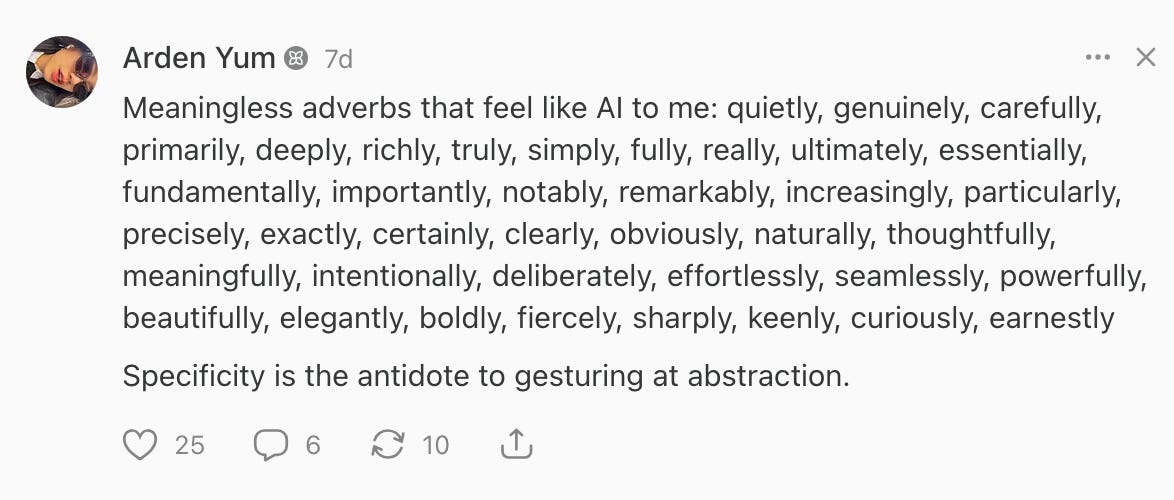
On Tuesday, when my own head was still woolly with cold, I succumbed to scrolling Substack Notes, which I hate doing because it’s turned a nice little publishing platform into yet another parade of bad feelings. Several of my mutuals restacked a note in which the author listed many adverbs that make a piece of writing sound like AI. In the list: my beloved “deeply.” The note was written by someone I don’t know, but on investigation, her newsletter, which also claims to be about culture and identity (though in her case, this apparently does not include long meditations on Wolf Hall), has approximately forty times more subscribers. The note came across my feed by way of a writer I deeply admire, who agreed that these adverbs were all markers of terrible AI writing. I don’t know why everyone seems to forget that LLMs were built on stolen books—which is why every chatbot sounds like it makes sense, even when the words it uses don’t add up in terms of meaning. If it uses em-dashes and adverbs, that’s because human writers do, too.
But even while I fumed, I made a mental note to hunt out the remaining adverbs in my book proposal. Control may be an illusion, but it’s all we’ve got.